


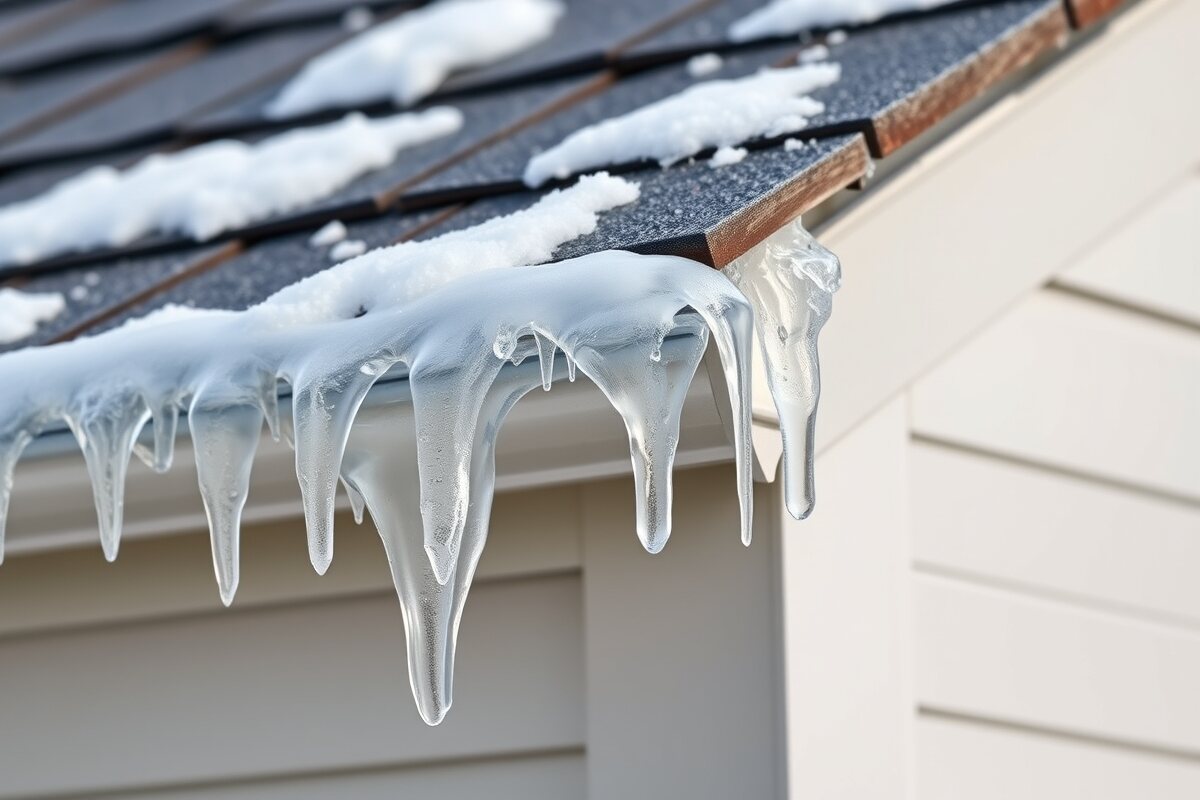
If you have ever watched thick icicles form along your gutters after a New England snowstorm, you have seen the warning sign of a much bigger problem. Ice dams are one of the most common and most damaging winter roofing issues we see across MetroWest Massachusetts, and they are almost always a symptom of what is happening inside your attic. In this guide, our team at Black Ladder Group explains exactly how ice dams form, how to stop them for good, and how to remove them safely without wrecking your roof.
What Are Ice Dams and Why Do They Matter?
An ice dam is a ridge of ice that builds up at the cold edge (eave) of your roof. On its own, ice at the roofline is not the real danger. The problem is the pool of trapped meltwater that forms behind the dam. That water has nowhere to drain, so it backs up under your shingles and finds its way into the roof deck, attic, insulation, walls, and ceilings below.
The result is often invisible until it is expensive: stained ceilings, peeling paint, soaked insulation, rotted framing, and mold. Because the water enters at the roof and travels down, homeowners frequently mistake ice dam leaks for general roof leaks and treat the symptom instead of the cause.
How Ice Dams Form: The Three Ingredients
Ice dams are not random. They require three conditions to occur at the same time, and every effective prevention strategy targets at least one of them:
- Snow cover on the roof to supply the water.
- Heat loss into the attic that warms the upper roof deck.
- Freezing outdoor temperatures at the eaves and overhangs.
Here is the cycle: warm air escaping into your attic melts the snow sitting on the upper part of the roof. That meltwater runs down the slope until it reaches the eave and the overhang, which hang past the heated part of the house and stay near or below freezing. There the water refreezes. As the cycle repeats, a dam of ice grows thicker, and the meltwater pooling behind it works its way beneath the shingles and into your home.
The Real Root Cause: A Warm Attic
It is tempting to blame the weather, but the true culprit is usually a roof deck that is too warm. If your attic stayed as cold as the outdoor air, the snow on your roof would not melt unevenly and ice dams would rarely form. Three attic issues combine to create that warmth:
- Air leaks (bypasses): recessed lights, the attic hatch, chimney chases, plumbing stacks, and gaps at wall top plates let warm household air pour into the attic.
- Insufficient insulation: too little insulation lets heat rise straight through the ceiling and warm the underside of the roof.
- Poor ventilation: without steady airflow, trapped heat has no way to escape before it melts the snow above.
This is why the most reliable fix is not on the roof at all: it is in the attic. For a deeper technical walkthrough, see our companion article on attic ventilation, insulation, and ice dams.
Chipping ice off a frozen roof treats the symptom for a day. Keeping the roof deck cold treats the cause for a lifetime.
Permanent Prevention That Actually Works
Stopping ice dams for good means keeping your roof deck cold and giving any water that does get past the shingles a barrier to stop it. In our MetroWest climate (Massachusetts sits in climate zone 5), we recommend a three-part approach plus a membrane backstop:
- Air-seal the attic bypasses. Seal every gap where warm air escapes: around recessed lights, the hatch, chimney chases, and top plates. This is the single highest-impact step.
- Add insulation to R-49 to R-60. Bringing attic insulation up to code-recommended levels keeps ceiling heat out of the attic.
- Balance the ventilation. Pair soffit intake vents with ridge exhaust vents so cold outdoor air continuously flushes the attic and keeps the deck cold.
- Install ice-and-water shield membrane. At the eaves and valleys, this self-sealing membrane is a New England best practice and the last line of defense: it blocks backed-up water even if a dam forms. It is standard on every roof replacement we install.
Save Money With Mass Save
Here is the best part for Massachusetts homeowners: the same air-sealing and insulation work that prevents ice dams often qualifies for Mass Save rebates covering roughly 75% of the cost, up to $2,000. You are effectively getting the state to help pay for the upgrade that protects your home all winter.
Safe Removal: Quick Fixes vs. Permanent Fixes
If an ice dam has already formed and water is threatening to get inside, you need to act, but safely. The table below separates temporary emergency measures from the permanent solutions.
| Approach | What It Does | Type |
|---|---|---|
| Roof rake (from the ground) | Removes snow from the lower 3–4 ft so no new dam can build | Quick fix |
| Calcium chloride ice-melt in a sock | Melts a channel through the dam to relieve trapped water | Quick fix |
| Heat cables | Keeps a drainage path open at the eave | Stopgap |
| Professional low-pressure steam | Safely melts an active dam without damaging shingles | Removal |
| Air-seal + insulate + ventilate | Keeps the roof deck cold so dams never form | Permanent fix |
Do & Don't for Ice Dam Removal
- Do rake snow off the lower 3–4 feet of roof from the ground after each storm: don't wait until 2+ feet has piled up.
- Do use calcium chloride ice-melt in a fabric sock laid across the dam to open a drainage channel.
- Do call a professional for low-pressure steam removal when a dam is already active and leaking.
- Don't use rock salt: it corrodes gutters, flashing, and shingles and stains masonry.
- Don't ever chip at ice with a hammer, axe, or shovel. You will shatter shingles and gutters, and the repair costs far more than the dam.
- Don't climb an icy, snow-covered roof. A ladder on ice is one of the most dangerous things a homeowner can attempt in winter.
If your dam is causing water damage or is out of safe reach, protect your gutters and roof by letting a licensed crew handle it. We serve homeowners throughout our MetroWest service area.
Ice Dams and Your Insurance
Many Massachusetts homeowners are surprised to learn that interior water damage caused by ice dams is often covered by standard homeowners policies. However, the preventive work (the air-sealing, insulation, and ventilation that stops dams from forming) is usually not covered, since insurers treat it as maintenance. Always document damage with photos and review your policy before filing. For a full breakdown of what coverage does and does not include, read our guide on whether homeowners insurance covers roof replacement in MA.
When to Call a Professional
Roof raking and ice-melt socks are reasonable homeowner tasks. Everything else (active leaks, steam removal, and the attic upgrades that prevent future dams) is work for a licensed, insured contractor. As a family-owned MetroWest roofing and exterior company (MA CSL 116010, HIC 205360), Black Ladder Group can diagnose the real cause behind your ice dams and fix it at the source rather than just clearing the ice. If you are seeing recurring ice dam problems every winter, that is a clear signal your attic needs attention.
Frequently Asked Questions
Do icicles always mean I have an ice dam?
Not always, but they are a red flag. Large icicles hanging from the eaves and gutters mean meltwater is refreezing at the cold roof edge, the same conditions that create ice dams. If you also see ice building up in a ridge along the eave, you likely have a dam and should monitor for interior leaks.
Will removing the snow from my roof stop ice dams?
Raking the lower 3–4 feet of roof after each storm is one of the most effective quick fixes because it removes the water source at the eave. It will not address the underlying attic heat loss, though, so pair it with air-sealing, insulation, and ventilation for a permanent solution.
Is calcium chloride safe for my shingles?
Yes, calcium chloride is the recommended ice-melt for roofs. Avoid rock salt (sodium chloride), which corrodes metal gutters and flashing and can damage shingles and masonry over time. Place the calcium chloride in a fabric sock laid perpendicular across the dam to melt a drainage channel.
Why do I get ice dams when my neighbor doesn't?
It usually comes down to attic performance. Differences in insulation levels, air leakage, ventilation, roof pitch, and even sun exposure change how much heat reaches your roof deck. A warmer attic melts snow faster and forms dams more readily, which is why the fix is inside the house.
Can ice dams be prevented before winter?
Absolutely, and fall is the ideal time. Air-sealing bypasses, topping up insulation to R-49–R-60, and balancing soffit-to-ridge ventilation are best done before the snow flies. Many of these upgrades qualify for Mass Save rebates, so the off-season is when you save the most.
Tired of fighting the same ice dams every winter? Black Ladder Group will inspect your roof and attic and give you a clear, free written estimate to fix the problem at its source. Schedule your free inspection today.

