


If you have battled ice dams on your MetroWest home, you have probably been told to buy a roof rake, install heat cables, or chip the ice off by hand. Those are treatments for a symptom. The real fix lives inside your attic. A cold, tightly sealed, well-ventilated attic keeps the roof deck cold across the whole surface, which stops the melt-and-refreeze cycle that builds ice dams in the first place. Get the attic right and you also extend shingle life, cut summer cooling costs, and prevent the hidden attic moisture that leads to mold and rot. Here is how attic ventilation and ice dams are connected, and the exact order of operations we use on roofs across Concord, Acton, Sudbury, and the surrounding towns.
Why Ice Dams Form (and Why the Roof Is Not the Cause)
An ice dam is a ridge of ice that forms at the eave, the coldest part of the roof. It starts when heat escaping from the living space warms the roof deck under the snowpack. Snow melts high on the roof, the water runs down to the cold overhang, and it refreezes. Repeat that over a few cold nights and the ice builds into a dam. Melt water then backs up behind it, works under the shingles, and finds its way into the ceiling and walls.
The shingles are not failing. The problem is a warm roof deck caused by escaping heat and poor airflow. That is why replacing shingles alone rarely ends the ice-dam cycle, and why we treat the attic as the primary system. For a full walkthrough of causes, prevention, and safe removal, see our companion guide on ice dams in New England and our ice dam problem page.
Balanced Ventilation: Intake and Exhaust in Harmony
Ventilation keeps the roof deck cold by moving outside air through the attic. It only works when it is balanced, roughly a 50/50 split between intake and exhaust. Intake comes from continuous soffit vents at the eaves. Exhaust leaves through a ridge vent at the peak. Cold air enters low, warms slightly, rises, and carries heat and moisture out the top. That constant wash of outside air keeps the deck temperature close to the outdoor air, so snow does not melt unevenly.
The building-code guideline for net free vent area (NFVA) is about 1 square foot of vent per 300 square feet of attic floor when you have a vapor barrier, or 1 per 150 without one. Split that total evenly between intake and exhaust.
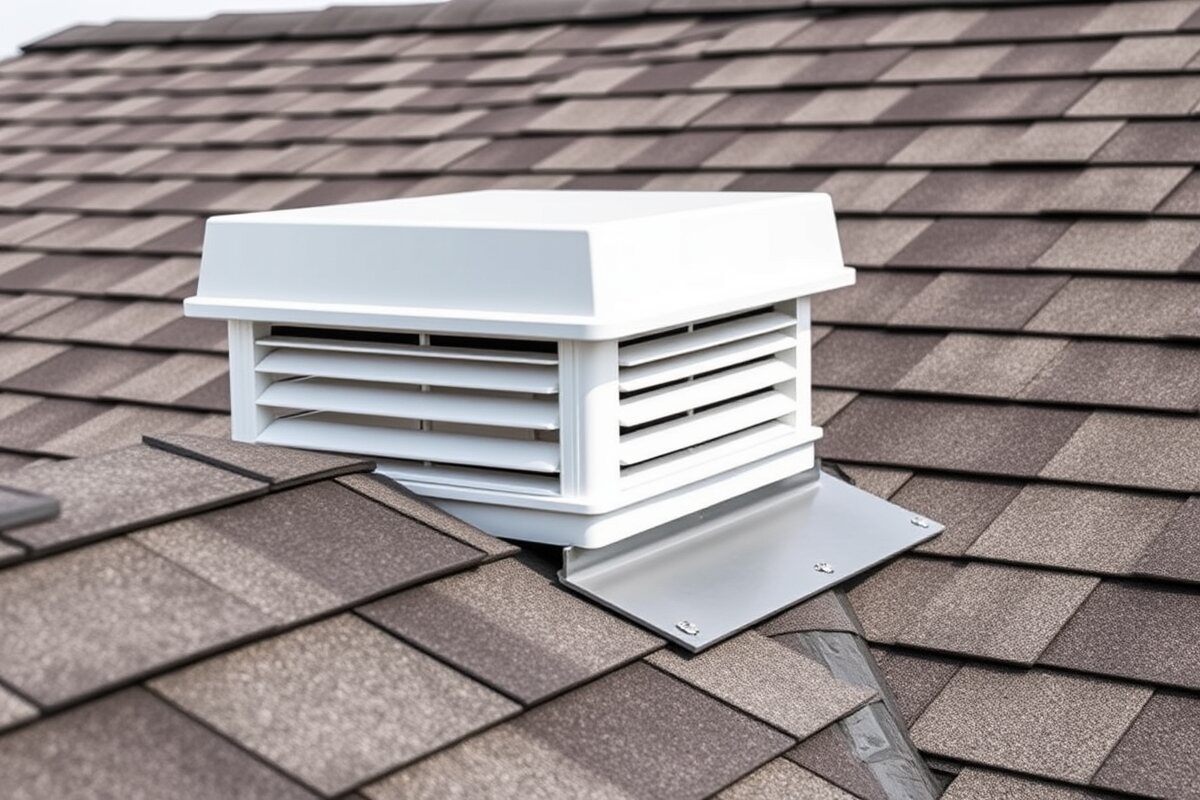
One critical rule: do not mix competing exhaust types. Pairing a ridge vent with a powered attic fan or gable vents short-circuits the airflow, the fan pulls air from the nearest opening (often the ridge vent itself) instead of drawing all the way from the soffits. The eaves stay stagnant, the deck stays warm at the edge, and ice dams return. One intake path and one exhaust path, sized to match, is the goal.
| Component | Location | Role |
|---|---|---|
| Soffit vents | Under the eaves | Intake (~50%) |
| Ridge vent | At the roof peak | Exhaust (~50%) |
| Baffles / chutes | Rafter bays at eaves | Keep insulation from blocking intake |
Insulation and Air Sealing: The Highest-Impact Step
Ventilation carries away the heat that reaches the attic. Insulation and air sealing stop that heat from getting there in the first place, and of the two, air sealing comes first. Warm indoor air leaks upward through dozens of small gaps: recessed light housings, the attic hatch, the chimney chase, plumbing and wiring penetrations, and the top plates of interior walls. Insulation laid over unsealed gaps underperforms, because moving air carries far more heat than it would ever conduct.
Massachusetts sits in climate zone 5. The target for attic insulation here is R-49 to R-60. Most older MetroWest homes we inspect fall well short, often sitting at R-19 to R-30 with significant air leakage on top of it.
You can pour in all the insulation you want, but if the attic still leaks warm air, the roof deck stays warm and the ice dams come back. Seal first, then insulate, then verify the airflow.
Common Air-Sealing Targets
- Recessed (can) lights, use IC-rated, airtight covers
- Attic hatch or pull-down stairs (weatherstrip and insulate the back
- Chimney chase) seal with fire-rated materials, never spray foam directly on a flue
- Wire and pipe penetrations, caulk or foam every hole
- Top plates of interior and exterior walls
The Correct Order of Operations
The sequence matters as much as the materials. Doing these steps out of order wastes money and leaves the ice-dam cycle intact. Here is the three-step plan we follow.
| Step | Action | Why It Matters |
|---|---|---|
| 1 | Air seal every attic penetration | Stops warm, moist air from reaching the deck |
| 2 | Insulate to R-49–R-60 | Keeps living-space heat where it belongs |
| 3 | Verify balanced intake & exhaust | Carries away any residual heat and moisture |
On the roofing side, the backstop is ice-and-water shield membrane at the eaves and in the valleys. It will not stop an ice dam from forming, but it creates a waterproof barrier so that if water does back up, it cannot leak into the home. We install it as standard on every roof replacement, and we pay special attention to sealing around any skylight, which is a common weak point for both leaks and heat loss.
What This Fix Delivers Beyond Ice Dams
Getting the attic right pays off in more than one season:
- Longer shingle life: a cooler deck means shingles are not baked from below in summer
- Lower cooling bills, a ventilated attic sheds summer heat instead of storing it above your ceilings
- No attic moisture or mold, exhaust airflow carries out the humidity that otherwise condenses on cold sheathing
- A more comfortable home, fewer cold ceilings and drafts in the rooms below
Mass Save Rebates in Massachusetts
Insulation and air sealing are among the best-subsidized home improvements in the state. Through Mass Save, most homeowners qualify for a free home energy assessment and rebates covering roughly 75% of insulation and air-sealing costs, up to $2,000. That dramatically lowers the cost of the highest-impact work in this article.
As a roofing and exterior contractor, Black Ladder Group assesses your ventilation and insulation as part of any roofing project. For deeper insulation retrofits, we can coordinate with Mass Save partners so the two efforts line up, ideally timed with a roof replacement. If you are weighing when to do the work, our guide on the best time of year to replace a roof in New England can help, and our financing options cover the roofing side.
Frequently Asked Questions
Will a powered attic fan fix my ice dams?
Usually not, and it can make things worse. A powered fan paired with a ridge vent short-circuits the airflow, pulling air from the nearest opening instead of drawing from the soffits. Balanced passive ventilation (continuous soffit intake plus a ridge vent) is more reliable and needs no electricity.
How much insulation do I need in a Massachusetts attic?
Massachusetts is climate zone 5, so the target is R-49 to R-60. Equally important, air-seal all penetrations before adding insulation, otherwise the new insulation cannot perform to its rating.
Do I still need ice-and-water shield if I fix the attic?
Yes. Attic work greatly reduces the chance of ice dams, but ice-and-water shield at the eaves and valleys is the waterproof backstop. We install it as standard on every roof replacement.
Can Black Ladder Group handle the insulation too?
We assess ventilation and insulation on every roofing project and address the roofing components directly. For deep insulation retrofits, we coordinate with Mass Save partners so the work aligns with your roof and you capture available rebates.
Not sure whether your attic is the culprit behind recurring ice dams? Black Ladder Group serves Concord, Acton, Sudbury, and the wider MetroWest area, and we will take a look. Schedule a free inspection and we will assess your ventilation, insulation, and roof together.

