


If you own a home in MetroWest Massachusetts, you already know how quickly gutters fill up. Between the oaks, maples, and pines that shade neighborhoods across Concord, Sudbury, and Acton, a set of open gutters can clog in a single autumn weekend. That leads a lot of homeowners to the same question: are gutter guards worth it? The honest answer is that they can be an excellent investment for the right house: but they are not magic, and they are only as good as the gutters and installation behind them. Below, we break down how gutters actually protect your roof, what gutter guards do (and don’t) accomplish, the different types available, realistic costs, and when they genuinely pay off.
Why Your Gutters Matter More Than You Think
Gutters have one job: channel the rainwater and snowmelt shedding off your roof safely away from the house. When they do that job, everything above and below stays dry. When they clog, sag, or overflow, water goes exactly where you don’t want it. A failing gutter system is one of the most common root causes behind expensive roof leaks and exterior rot we see on service calls.
Here is what neglected or overwhelmed gutters actually cause:
- Fascia & soffit rot, water spilling behind the gutter soaks the wood trim at the roof edge until it softens and fails.
- Roof-edge & sheathing damage, standing water wicks under shingles and into the decking, shortening the life of your roof.
- Foundation & basement water: overflow pools next to the house, seeps down, and ends up in the basement or undermines the foundation.
- Worse ice dams in winter, clogged gutters trap water and ice at the eaves, giving ice dams a place to form and grow. That backed-up ice forces meltwater under the shingles.
In other words, your gutters are a frontline defense for your entire roof system, not just a rain accessory. Keeping them flowing is one of the cheapest forms of roof protection there is.
What Gutter Guards Actually Do
Gutter guards are covers or inserts that sit over (or inside) your gutters to keep leaves, needles, and debris out while letting water in. The goal is fewer clogs, fewer overflows, and dramatically less time on a ladder. For tall or steep roofs common in older New England homes, that safety benefit alone is meaningful.
But here is the honest caveat we give every customer: guards reduce maintenance, they do not eliminate it. Fine grit, shingle granules, and pollen can still accumulate, and any guard can be overwhelmed if the gutters themselves are undersized, pitched wrong, or poorly installed. Quality of the product and correctness of the installation matter far more than the brand name on the box.
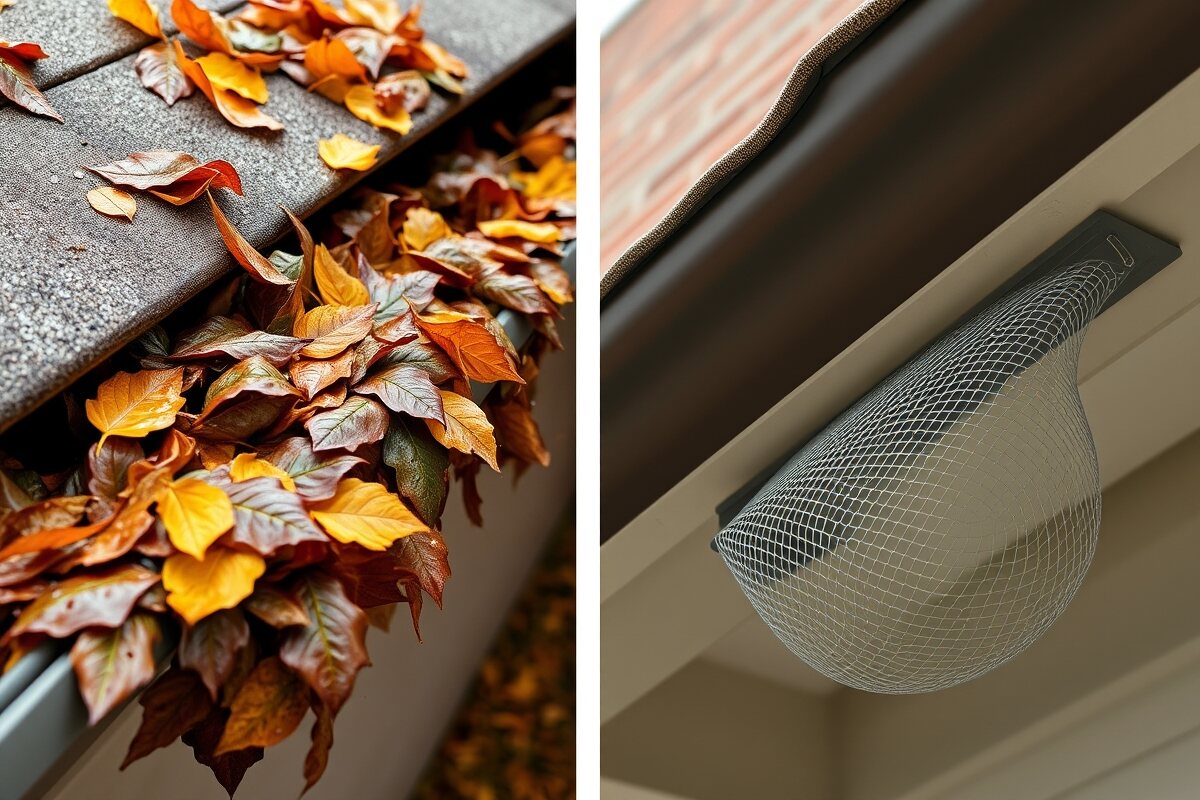
Types of Gutter Guards Compared
Not all guards are built the same, and the right choice depends on your trees, your roof pitch, and your budget. Here are the main categories:
- Micro-mesh, a fine stainless or aluminum screen that blocks even pine needles and shingle grit. Best overall filtration; higher cost.
- Perforated aluminum screens, punched metal panels that stop leaves and larger debris. A solid mid-range value.
- Reverse-curve / surface-tension, solid covers that guide water around a nose while leaves fall off. Sheds leaves well but can overshoot in heavy downpours and is the priciest option.
- Foam inserts, blocks of foam set inside the gutter. Cheap and DIY-friendly, but shorter life and can hold debris on top.
- Brush, bottle-brush cylinders laid in the trough. Inexpensive and simple, but debris catches in the bristles.
| Guard Type | Filtration | Best For | Relative Cost |
|---|---|---|---|
| Micro-mesh | Excellent (fine debris & pine needles) | Pine, oak & maple-heavy lots | High |
| Perforated aluminum | Good (leaves, twigs) | Mixed hardwood yards | Medium |
| Reverse-curve | Good (sheds leaves) | Broadleaf trees, low grit | Highest |
| Foam insert | Fair | Budget / short-term | Low |
| Brush | Basic | Light debris, quick fix | Low |
What Gutter Guards Cost
Pricing varies with material, roof height, and how much linear footage your home needs, but these national/typical ranges give you a realistic starting point:
- Seamless gutters (installed): roughly $8–$28 per linear foot; standard aluminum runs about $6–$20 per foot.
- Gutter guards: roughly $7–$20 per linear foot for mesh and screen styles.
- Premium reverse-curve guards: about $22–$38 per linear foot.
These are ballpark figures, not a quote. The only way to know your number is a written estimate after someone measures your roofline and inspects your existing gutters. Black Ladder Group provides that estimate free after an on-site inspection.
Seamless vs. Sectional Gutters
Before you spend money on guards, it is worth looking at the gutters underneath them. Seamless gutters are formed from a single continuous piece of aluminum on site, so the only joints are at corners and downspouts. Sectional gutters are assembled from shorter pre-cut pieces joined together: and every seam is a potential leak point that eventually separates or corrodes.
Fewer seams mean fewer leaks, less maintenance, and a cleaner surface for guards to sit on. If your existing gutters are old, leaky, or sagging, pairing new seamless gutters with quality guards usually delivers far better results than bolting guards onto a failing system. Learn more about our gutter installation and repair services.
So: Are Gutter Guards Worth It for Your Home?
For many MetroWest homes, yes. Guards tend to pay off clearly in these situations:
- You have lots of trees. MetroWest is genuinely leaf-heavy: oak, maple, and pine constantly shed into gutters. High debris load is the single best case for quality guards.
- Your roof is tall or steep. If cleaning your gutters means a dangerous ladder position, guards dramatically cut the frequency and risk of that chore.
- You deal with recurring clogs and overflow. If you’re cleaning gutters two or three times a year, guards can reclaim that time.
- You want to reduce ice-dam risk. Keeping the eaves clear of trapped debris helps water drain before it freezes. Guards won’t cure a poorly insulated attic, but they remove one contributing factor.
The best gutter guard is the one installed on a properly sized, correctly pitched gutter by someone who inspected your roof first. Skip that step and even the priciest guard will disappoint.
If your trees are minimal and your gutters are easy to reach and rarely clog, guards may be a nice-to-have rather than a need-to-have. That’s the honest read, and it’s exactly why we inspect before we recommend anything. For a broader look at how these systems tie into your roof through the seasons, see our guides on ice dams in New England and the best time of year to replace a roof.
Frequently Asked Questions
Do gutter guards completely stop me from cleaning my gutters?
No. Good guards keep out the bulk of leaves and debris and can extend cleaning intervals from a few times a year to occasional touch-ups. Fine grit, pollen, and shingle granules can still collect over time, so plan on periodic checks, just far less often than with open gutters.
Which gutter guard is best for pine needles?
Micro-mesh guards are the top performer for fine debris like pine needles and shingle grit, because the openings are small enough to block what screens and reverse-curve covers let through. If you have pines on your lot, micro-mesh is usually the right call.
Will gutter guards prevent ice dams?
Not on their own. Ice dams are driven mainly by attic heat loss and poor ventilation. Guards help by keeping the eaves free of trapped debris so meltwater can drain, which removes one contributing factor: but the real fix is proper insulation, ventilation, and a sound roof edge.
Can I add guards to my existing gutters?
Often, yes: if your current gutters are seamless or in good shape, correctly pitched, and firmly attached. If they’re leaking, sagging, or undersized, you’ll get much better long-term results by replacing them at the same time. An inspection tells us which path makes sense for your home.
Are gutter guards worth it on a single-story house that’s easy to clean?
It depends on your trees. With heavy leaf and needle drop, guards still save real time and reduce overflow. With light debris and easy access, the payback is smaller, and you may reasonably choose to stick with routine cleaning.
Not sure whether guards make sense for your home? Black Ladder Group offers a free gutter and roof inspection across Concord, Acton, Sudbury, Maynard, and the surrounding MetroWest towns, schedule your free inspection and we’ll give you an honest recommendation and a written estimate.

